Nursery Bedding Guide
A Thoughtful Nursery Sleep Setup: What to Consider Before Choosing Bedding
A nursery sleep setup is built from practical decisions: a mattress that fits the crib, a firm and level surface for an infant, and bedding that can be cleaned as often as family life requires. Material choices matter, too—but they work best when considered alongside safe-sleep guidance, care instructions, and the actual dimensions of the sleep space.
Published November 22, 2026
Preparing a nursery can feel like a series of small choices with unusually large emotional weight. A mattress is not simply another item on a list. It is the foundation of a sleep space used night after night, through spills, laundry cycles, growth spurts, and changes in routine. The bedding that goes over it can affect how easy the space is to maintain, how the surface feels, and whether the mattress remains protected.
Yet more layers do not necessarily make a better infant sleep setup. For a baby, the priority is a firm, flat, appropriately fitted sleep surface with only the bedding permitted by current safe-sleep guidance. Soft toppers, loose blankets, pillows, quilts, and stuffed items should not be added to an infant’s sleep area. Families should follow advice from their pediatrician and current recommendations from recognized public-health authorities, particularly as guidance may be updated.
This guide takes a measured approach to nursery bedding and organic crib mattresses. It explains how to start with fit, what material labels can and cannot tell you, how to plan for washing, and why the simplest setup is often the most useful one.
Begin with the crib and mattress fit
Before comparing cotton covers or certifications, confirm what size mattress the crib is designed to hold. “Standard crib mattress” is a common description, but the decisive issue is the fit inside the specific crib. Check the crib’s manual and the mattress dimensions, including length, width, and thickness. A mattress that is too small can leave gaps at the sides; one that is too large or too thick may not sit correctly in the frame or may interfere with the crib’s intended configuration.
Once the mattress is in place, check that it rests flat and securely on the support system and that the fitted sheet is designed for its dimensions and depth. The sheet should not come loose or bunch when fitted. Do not try to compensate for an unsuitable mattress with extra padding, folded blankets, or improvised spacers. If you are uncertain about compatibility, consult the crib and mattress manufacturers rather than relying on a general size chart alone.
Fit deserves particular attention when a mattress has unusual dimensions, a two-stage design, or a removable top pad. Confirm which component is included in the stated measurements and whether the maker specifies a compatible sheet. Keep the product instructions available; details such as which side faces up, how a cover attaches, and whether a layer is removable can be easy to forget after setup.
A quick fit check
- Compare the mattress measurements with the crib manual.
- Confirm the mattress sits flat on its support and does not rock or bow.
- Use a fitted sheet made for the mattress size and depth.
- Check that the sheet stays taut and secure at the corners.
- Follow the manufacturers’ instructions if the mattress has multiple sides or removable components.
Keep infant bedding simple
In a nursery, decorative styling and infant sleep requirements are not the same thing. A coordinated quilt may look at home on a chair, but it should not be placed loose in an infant’s sleep area. The same caution applies to pillows, comforters, positioners, bumpers, and soft toys. For sleep, use a firm, flat mattress with a properly fitted sheet, and keep the sleep space clear in keeping with current safe-sleep recommendations.
That simplicity is practical as well as safety-conscious. Fewer layers mean fewer items to shift, wash, or put back in place. They also make it easier to see whether the mattress cover or sheet needs attention. If a baby needs warmth, ask a pediatric health professional about appropriate sleep clothing or wearable blankets rather than adding loose bedding.
Mattress pads and toppers require special care in this context. Some are designed as adult comfort layers, while others are intended to protect a crib mattress. A product described as natural, organic, breathable, or washable is not automatically appropriate for an infant’s sleep surface. Consider the intended age, construction, fit, and manufacturer’s directions, and do not add a layer that changes the mattress’s firmness or flatness unless it is specifically designed for that use and consistent with safe-sleep guidance.
What “organic” means—and what it does not
Organic crib mattresses attract families who want to understand the materials in their home. The term can refer to particular fibers or agricultural inputs, but it does not, by itself, describe every part of a finished mattress. A mattress may contain several components: a core, cushioning, a fabric cover, seams, adhesives or barriers, and a surface treatment. The label should be read as a starting point for questions, not as a complete account of construction.
Certifications can make that account more specific. GOTS, for example, is associated with organic textile processing and includes criteria for relevant supply-chain stages and environmental and social considerations. GOLS relates to organic latex and sets requirements for certified organic latex products and their processing chain. A certification applies within its defined scope; it is important to check which material or component is covered, and whether the finished product is certified or merely contains a certified component.
OEKO-TEX Standard 100 is a different kind of claim: it focuses on testing textile products for specified harmful substances. It is not the same as an organic certification. A product can meet a testing standard without being organic, and an organic claim does not answer every question about emissions, construction, or performance. Read the certificate details and the product’s full material disclosure rather than treating a logo as a universal guarantee.
Helpful questions for a manufacturer include: Which components are certified? Is the finished mattress covered by the certification, or only the cotton, wool, or latex? What materials are used in the waterproof layer or fire barrier? Are care instructions available? Can the company provide current certification details? Clear answers are more valuable than broad promises such as “chemical-free,” a phrase that is often imprecise because all physical materials are made of chemicals.
Materials commonly found in nursery bedding
Organic cotton is widely used in crib sheets, mattress covers, and pads. Its feel and performance depend on factors such as knit or weave, fabric weight, construction, and finishing. A soft cotton surface may be comfortable, but softness alone does not determine whether a particular product is right for an infant sleep setup. Fit and intended use remain essential.
Wool appears in some mattress upholstery and bedding because it can absorb moisture and help moderate temperature. It is not automatically suitable as a loose crib layer, and wool-containing products should be used only as directed. Families should also review care instructions and consider any known sensitivities.
Latex may be used in mattress cores or pillows for adults, but a latex product is not interchangeable with a crib mattress. For nursery use, focus on the exact product design, applicable safety requirements, and the manufacturer’s intended age and use. If a household member has a latex allergy or sensitivity, discuss exposure concerns with a qualified clinician and ask the maker about the specific materials and whether they are enclosed.
Waterproof barriers also vary. Some crib mattresses have a wipe-clean surface, while others use a separate washable pad or a laminated textile. A barrier can make routine cleanup easier, but the term “breathable” should not replace careful review of construction or safe-sleep advice. Ask what the barrier is made from, how it should be cleaned, and whether it is an integral part of the mattress or a removable accessory.
Washability is part of the design
Nursery bedding has a demanding job. It may need to handle milk, spit-up, diaper leaks, and frequent changes without losing its shape or fit. Before buying, find out what can be machine washed, what requires spot cleaning, and whether the mattress itself must only be wiped down. A removable, washable cover can be convenient, but the instructions should explain how to remove and reinstall it correctly.
Check the recommended water temperature, detergent guidance, drying method, and any restrictions on bleach or fabric softener. High heat can shrink textiles or damage waterproof membranes; harsh cleaners may affect finishes. A sheet that shrinks substantially can become difficult to fit safely, so follow the care label and inspect its fit after washing.
It is useful to keep a spare fitted sheet and, where appropriate, an extra manufacturer-approved washable cover. That makes it easier to restore the sleep space promptly without reaching for an improvised substitute. Store spare bedding clean and dry. If a mattress or pad becomes soaked, clean and dry it exactly as the manufacturer directs; do not cover damp materials, since trapped moisture can lead to odor or damage.
Understanding two-stage crib mattresses
Some crib mattresses have one side intended for infants and another intended for toddlers. The surfaces may differ in firmness, and the product instructions will specify when and how to turn the mattress. A two-stage design can offer a longer period of use, but it does not mean the mattress changes automatically as a child grows. Follow the maker’s directions and confirm that the mattress remains compatible with the crib in each configuration.
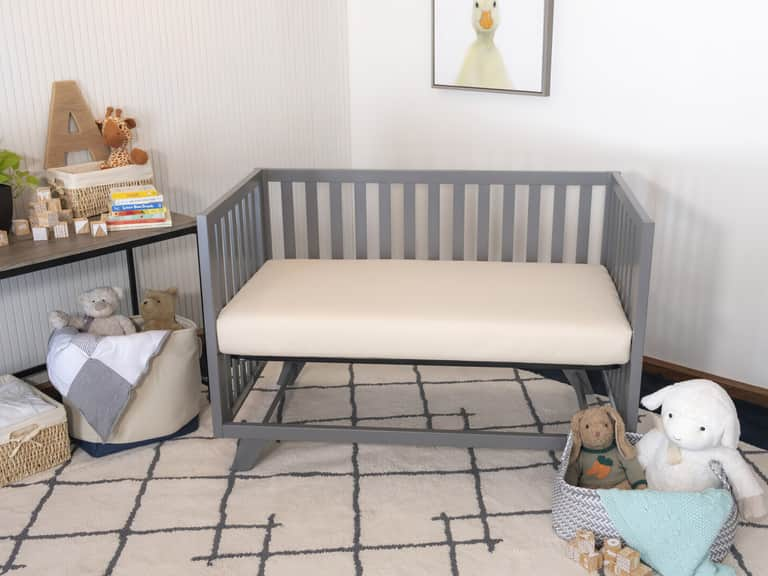
One example is the Naturepedic Breathable 2-Stage Organic Crib Mattress, which is described as having an infant side and a toddler side, along with a removable, washable mattress pad. Its listed dimensions are approximately 27¼ by 51⅝ by 6 inches, so checking those measurements against the crib’s specifications is important. The product information also describes a wipe-clean waterproof surface and a cotton construction. As with any mattress, families should review the current product documentation and follow the intended-use and care instructions rather than relying on a brief description alone.
A mattress marketed as breathable may have a particular construction or accessory intended to promote airflow. That description should not be taken to mean that other safe-sleep measures are unnecessary, or that a baby can be placed in any position or surrounded by additional objects. Product features and public-health guidance answer different questions: one concerns the product’s design; the other concerns the infant’s sleep environment.
A practical way to compare options
When evaluating organic crib mattresses, compare like with like. One product may emphasize a cotton core, another an innerspring construction, and another a removable pad or dual-sided surface. A lower price is not automatically a compromise, and a higher price does not automatically mean a better fit for your family. The relevant question is whether the mattress meets applicable requirements, fits the crib, suits your care routine, and provides clear information about materials and maintenance.
- Dimensions: Are the measurements compatible with the crib, including the mattress depth?
- Surface: Is the sleep surface firm, flat, and intended for the infant’s age and use?
- Construction: What is inside the mattress, and how are its layers assembled?
- Water resistance: Is protection built in, or does the manufacturer specify a separate accessory?
- Certifications: Which exact materials or components are covered by each certification?
- Care: What can be washed, wiped, or spot-cleaned, and how should it be dried?
- Longevity: Does the product have a defined warranty, and what does the warranty exclude?
- Transparency: Can the manufacturer answer questions about materials and intended use clearly?
Keep the crib manual, mattress instructions, and care labels together. If the mattress is passed along to another family, provide those documents too. A product’s condition matters: follow manufacturer guidance on inspection, storage, and replacement, and do not use a mattress that is damaged, misshapen, or no longer fits securely.
Design the room around the sleep space—not into it
Nursery design often begins with color, texture, and a desire to make a room welcoming. Those aims can be met outside the crib. Choose wall finishes, curtains, storage, and decorations that create the atmosphere you want, while keeping the infant’s sleep area uncluttered. Place frequently used sheets and cleaning supplies within adult reach but away from the crib, and make sure cords from blinds or monitors are kept well clear of the sleep space.
Temperature and ventilation are also worth considering. A comfortable room does not require heavy bedding in the crib. Dress the baby appropriately for the room and ask a clinician if you are unsure how to judge warmth. Avoid relying on a mattress material claim as a substitute for checking the baby’s clothing, room conditions, or general wellbeing.
Common questions about nursery bedding
Does an organic crib mattress automatically make a sleep space safer?
No single material label can establish that an entire sleep space is safe. Organic claims relate to defined materials or processing standards; safe-sleep decisions also involve mattress fit, firmness, correct use, and keeping the infant sleep area clear. Review the product details and follow current professional guidance.
Should I use a mattress topper for extra comfort?
Do not add a comfort topper or other soft layer to an infant’s sleep surface unless the manufacturer specifically designs it for the crib mattress and its use is consistent with current safe-sleep guidance. A product described as natural or organic is not necessarily appropriate as an added infant layer.
Are waterproof mattress covers always necessary?
Needs vary by mattress construction and household routine. Some mattresses have a wipe-clean surface; others may be used with a manufacturer-approved protective layer. Check the instructions for the specific mattress, and avoid adding accessories that affect fit or firmness.
What is the most important thing to check when buying a fitted sheet?
Start with compatibility. Confirm that the sheet is intended for the mattress’s dimensions and depth, then check that it fits tightly and stays in place. Fiber content and texture can help guide comfort preferences, but they cannot make an ill-fitting sheet suitable.
A calmer checklist for a considered choice
A thoughtful nursery setup does not depend on assembling the most elaborate collection of bedding. It depends on making a few decisions carefully: verify dimensions before purchasing, understand what each material claim covers, choose products with clear care directions, and keep the infant’s sleep space simple. When a question turns on medical needs, allergies, or safe-sleep practice, consult a pediatric professional and the relevant official guidance.
Organic crib mattresses and natural-fiber bedding can be part of a considered home, especially for families who value material transparency and durable construction. Their labels are most useful when read precisely. Look beyond the headline claim to the core, cover, barrier, certification scope, and care routine. Then let fit and intended use lead the decision.
The result need not be complicated: a correctly fitted mattress, a taut fitted sheet, a clear sleep area, and a plan for keeping everything clean. That is a nursery sleep setup designed not for display, but for the everyday reality of caring for a growing child.